Skip to product information
1 of 4
Books-Philosophy

Beyond Good and Evil

₹199 ₹299 33% off

You save ₹100

Inclusive of all taxes

15 people viewing now
Shop with peace of mind
Make it special+₹ 49.00
Qty
Added to cart successfully.
Offers
Share
WhatsApp
Link copied.
View full details

The book which challenged the existing dogmas and principle of its times Containing 296 aphorisms, Friedrich Nietzsche’s Beyond Good and Evil critiques Christian morality and the philosopher’s ideas of truth, and explores his own philosophical take on human psychology. This book looks into concepts about ‘the free spirit’, nationalism, moral concepts of good and evil and the virtues of European culture. Nietzsche became an outspoken critic of German nationalism, anti-Semitism and religious dogmatism. Before collapsing and suffering a nervous breakdown in 1889, which left him in a vegetative state till 1900—the year of his death—Nietzsche wrote Beyond Good and Evil, On the Genealogy of Morality, Twilight of the Idols, The Antichrist, Ecce Homo, The Case of Wagner and Nietzsche Contra Wagner between 1886 and 1888.

Product Highlights
Full specifications at a glance
Publisher ‏
- ‎ Lexicon Publication
Language ‏
- ‎ English
Format
Paperback
ISBN-13
9789393050786
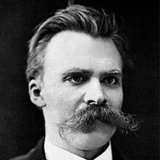
Friedrich Nietzsche

Friedrich Nietzsche

Friedrich Wilhelm Nietzsche (15 October 1844 – 25 August 1900) was a widely influential German philosopher. He began his career as a classical philologist, turning to philosophy early in his academic career. In 1869, aged 24, Nietzsche became the youngest professor to hold the Chair of Classical Philology at the University of Basel. Plagued by health problems for most of his life, he resigned from the university in 1879, after which he completed much of his core writing in the following decade. In 1889, aged 44, he suffered a collapse and thereafter a complete loss of his mental faculties, with paralysis and vascular dementia. He lived his remaining years under the care of his family until his death in 1900. His works and his philosophy have fostered not only extensive scholarship, but also much popular interest. Nietzsche's work spans philosophical polemics, poetry, cultural criticism, and fiction while displaying a fondness for aphorism and irony. Prominent elements of his philosophy include his radical critique of truth in favour of perspectivism; a genealogical critique of religion and Christian morality and a related theory of master–slave morality; the aesthetic affirmation of life in response to both the "death of God" and the profound crisis of nihilism; the notion of Apollonian and Dionysian forces; and a characterisation of the human subject as the expression of competing wills, collectively understood as the will to power. He also developed influential concepts such as the Übermensch and his doctrine of eternal return. In his later work, he became increasingly preoccupied with the creative powers of the individual to overcome cultural and moral mores in pursuit of new values and aesthetic health. His body of work touched a wide range of topics, including art, philology, history, music, religion, tragedy, culture, and science, and drew inspiration from Greek tragedy as well as figures such as Zoroaster, Arthur Schopenhauer, Ralph Waldo Emerson, Richard Wagner, Fyodor Dostoevsky, and Johann Wolfgang von Goethe.
About the author Friedrich Nietzsche
19th-century German philosopher, originator of concepts including the will to power, the Übermensch, and the death of God

Friedrich Wilhelm Nietzsche (15 October 1844 – 25 August 1900) was a widely influential German philosopher. He began his career as a classical philologist, turning to philosophy early in his academic career. In 1869, aged 24, Nietzsche became the youngest professor to hold the Chair of Classical Philology at the University of Basel. Plagued by...