Skip to product information
1 of 2
Books-Biography

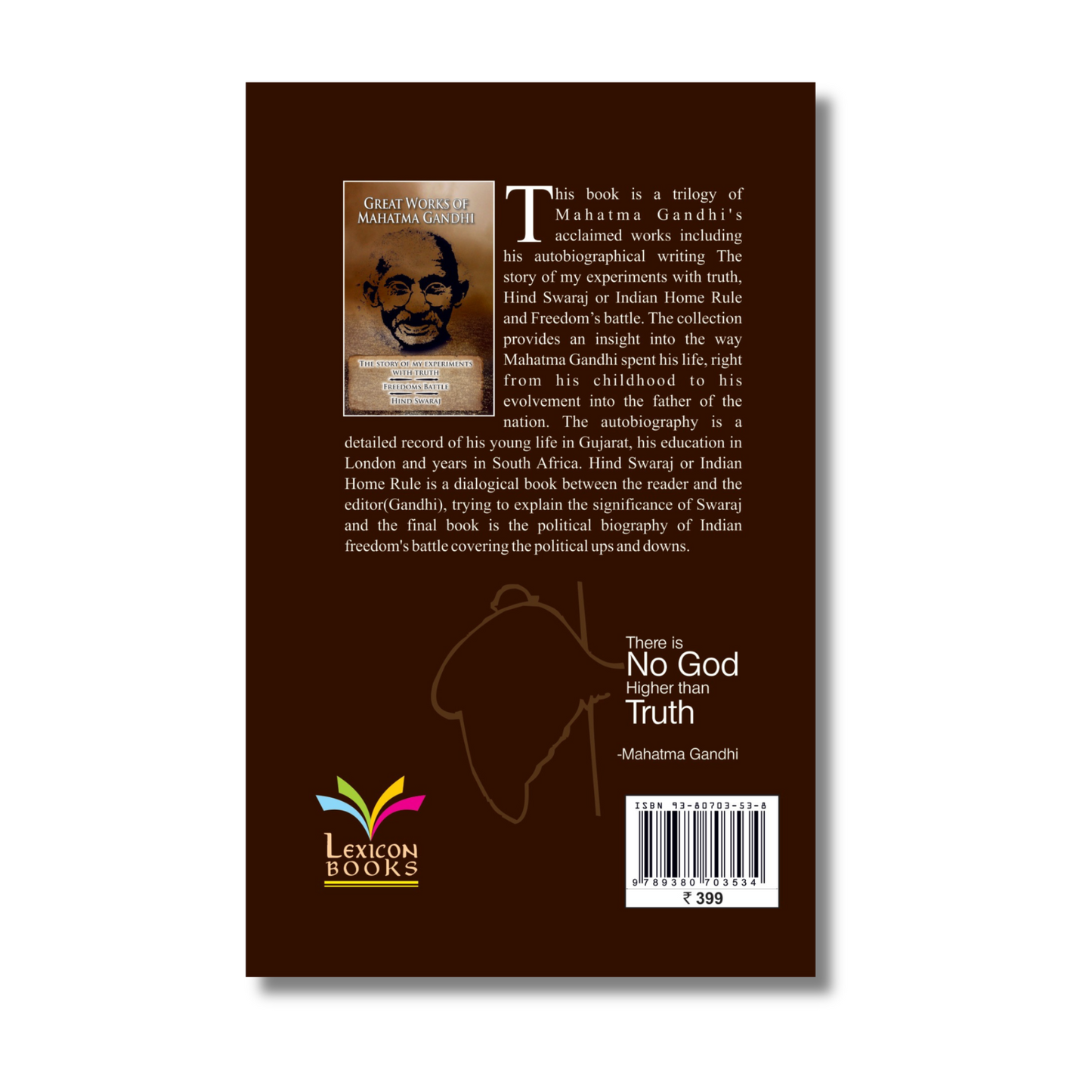
Great Works Of Mahatma Gandhi

₹349 ₹399 13% off

You save ₹50

Inclusive of all taxes

33 people viewing now
Shop with peace of mind
Make it special+₹ 49.00
Qty
Added to cart successfully.
Offers
Share
WhatsApp
Link copied.
View full details

This vintage book contains the complete collected works of Mahatma Ghandi. This wonderful and comprehensive collection would make for a fine addition to any bookshelf, and will be of particular value to those with a keen interest in the life and mind of this great man. Mohandas Karamchand Gandhi (1869 - 1948) led the Indian independence movement in British-ruled India, and is one of the most influential and important advocates of non-violent civil disobedience and civil rights. Many antiquarian books such as this are increasingly hard-to-come-by and expensive, and it is with this in mind that we are republishing this book now in an affordable, modern edition - complete with a specially commissioned new biography of the author.

Product Highlights
Full specifications at a glance
Publisher ‏
- ‎ Lexicon Publication
Language ‏
- ‎ English
Format
Paperback
ISBN-13
9789380703534
Mahatma Gandhi

Mahatma Gandhi

Mohandas Karamchand Gandhi (2 October 1869 – 30 January 1948) was an Indian lawyer, anti-colonial nationalist, and political ethicist who employed nonviolent resistance to lead the successful campaign for India's independence from British rule. He inspired movements for civil rights and freedom across the world. The honorific Mahātmā (from Sanskrit, meaning great-souled, or venerable), first applied to him in South Africa in 1914, is now used throughout the world. Born and raised in a Hindu family in coastal Gujarat, Gandhi trained in the law at the Inner Temple in London and was called to the bar at the age of 22. After two uncertain years in India, where he was unable to start a successful law practice, Gandhi moved to South Africa in 1893 to represent an Indian merchant in a lawsuit. He went on to live in South Africa for 21 years. Here, Gandhi raised a family and first employed nonviolent resistance in a campaign for civil rights. In 1915, aged 45, he returned to India and soon set about organising peasants, farmers, and urban labourers to protest against discrimination and excessive land tax. Assuming leadership of the Indian National Congress in 1921, Gandhi led nationwide campaigns for easing poverty, expanding women's rights, building religious and ethnic amity, ending untouchability, and, above all, achieving swaraj or self-rule. Gandhi adopted the short dhoti woven with hand-spun yarn as a mark of identification with India's rural poor. He began to live in a self-sufficient residential community, to eat simple food, and undertake long fasts as a means of both introspection and political protest. Bringing anti-colonial nationalism to the common Indians, Gandhi led them in challenging the British-imposed salt tax with the 400 km (250 mi) Dandi Salt March in 1930 and in calling for the British to quit India in 1942. He was imprisoned many times and for many years in both South Africa and India.
About the author Mahatma Gandhi
Father of the Indian nation and leader of India's non-violent freedom struggle

Mohandas Karamchand Gandhi (2 October 1869 – 30 January 1948) was an Indian lawyer, anti-colonial nationalist, and political ethicist who employed nonviolent resistance to lead the successful campaign for India's independence from British rule. He inspired movements for civil rights and freedom across the world. The honorific Mahātmā (from Sanskrit, meaning great-souled, or venerable), first...

More by this author · 2 in store