1
/
of
2
Lexicon
Poetics
Poetics
By
Aristotle
(Author)
Paperback
Regular price
Rs. 165.00
Regular price
Rs. 199.00
Sale price
Rs. 165.00
Unit price
/
per
Christmas Sale
Taxes included.
Free Shipping Over Rs 499
Couldn't load pickup availability
Shipping & Services
Estimated Delivery
—
Pan-India · Mon–Sun
Shipping
Free over ₹499
Auto-applied at checkout
Replacement
Payments
COD Available
Secure via Razorpay
UPI · Cards · Netbanking
Note: Delivery time may vary.
Coupons & Offers
Most popular
Get ₹10 OFF
Buy any 2 Books
LITTLEGYAAN
Get ₹20 OFF
Buy over ₹499
GYAANI20
Get ₹50 OFF
Buy over ₹999
GYAANI50
Get ₹120 OFF
Buy over ₹1999
GYAANI120
Get 10% OFF
Buy over 10 qty
GYAAN10
Get 15% OFF
Buy over 20 qty
GYAAN15
Coupon copied!
Share

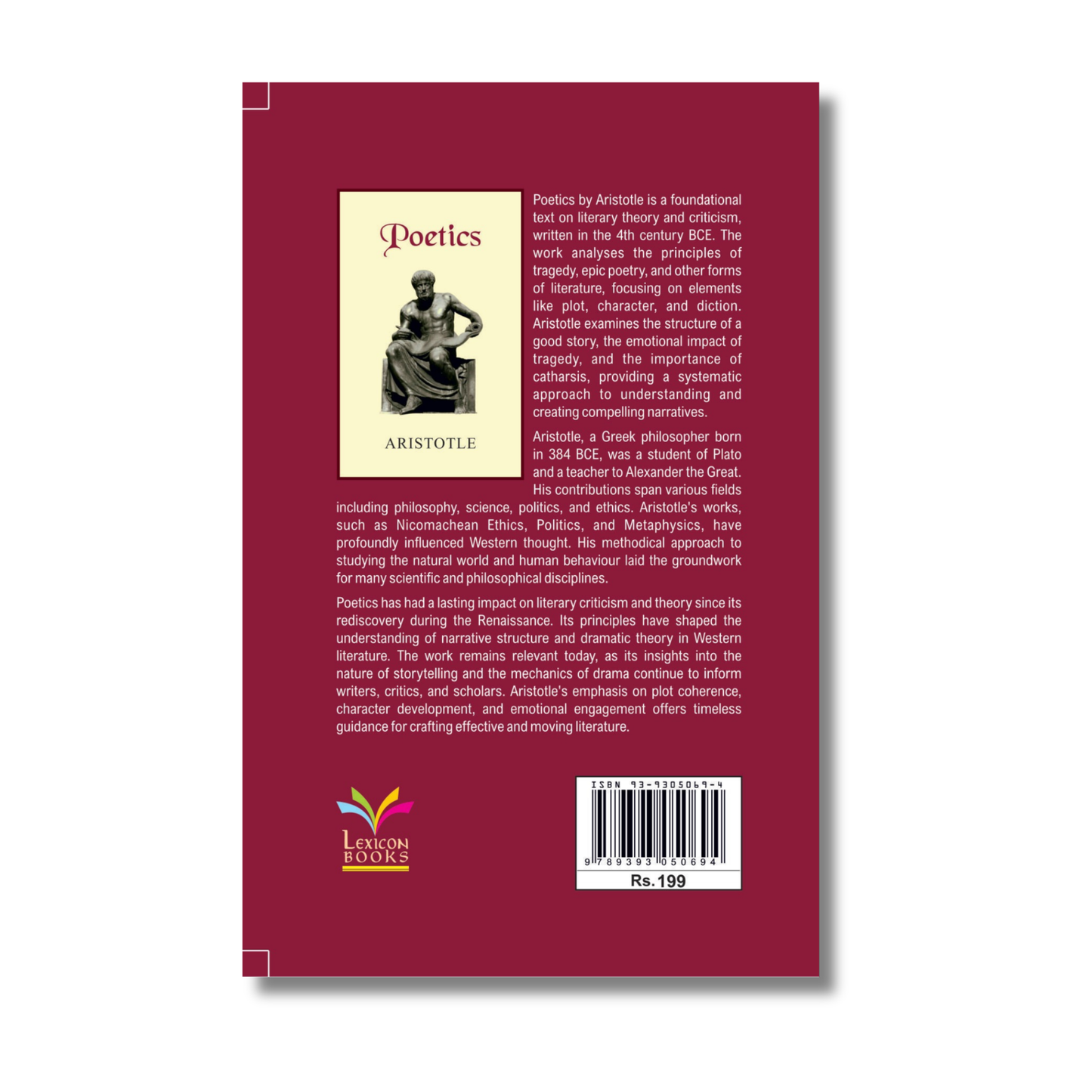
In one of the most perceptive and influential works of criticism in Western literary history, third century B.C. Greek philosopher Aristotle examines the literature of his time, describing the origins of poetry as an imitative art and drawing attention to the distinctions between comedy and tragedy. Aristotle helped establish the foundations of Western philosophy, and his influence is evident in philosophical thought today.
Highlights
| Publisher | - Lexicon Publication |
| Language | - English |
| Format | Paperback |
| ISBN-13 | 9789393050861 |
Aristotle
Aristotle 384–322 BC) was a Greek philosopher and scientist born in the city of Stagira, Chalkidice, on the northern periphery of Classical Greece. His father, Nicomachus, died when Aristotle was a child, whereafter Proxenus of Atarneus became his guardian. At eighteen, he joined Plato's Academy in Athens and remained there until the age of thirty-seven (c. 347 BC). His writings cover many subjects – including physics, biology, zoology, metaphysics, logic, ethics, aesthetics, poetry, theater, music, rhetoric, linguistics, politics and government – and constitute the first comprehensive system of Western philosophy. Shortly after Plato died, Aristotle left Athens and, at the request of Philip of Macedon, tutored Alexander the Great starting from 343 BC. According to the Encyclopædia Britannica, "Aristotle was the first genuine scientist in history ... [and] every scientist is in his debt."
Teaching Alexander the Great gave Aristotle many opportunities and an abundance of supplies. He established a library in the Lyceum which aided in the production of many of his hundreds of books. The fact that Aristotle was a pupil of Plato contributed to his former views of Platonism, but, following Plato's death, Aristotle immersed himself in empirical studies and shifted from Platonism to empiricism. He believed all peoples' concepts and all of their knowledge was ultimately based on perception. Aristotle's views on natural sciences represent the groundwork underlying many of his works.
Aristotle's views on physical science profoundly shaped medieval scholarship. Their influence extended into the Renaissance and were not replaced systematically until the Enlightenment and theories such as classical mechanics. Some of Aristotle's zoological observations, such as on the hectocotyl (reproductive) arm of the octopus, were not confirmed or refuted until the 19th century. His works contain the earliest known formal study of logic, which was incorporated in the late 19th century into modern formal logic.
-
Fast Delivery
Orders will Dispatch usually be within 2 Days
-
Easy Exchange
We have 3 Days Replacement/Exchange Policy.
-
Easy Support
Whatsapp Chat :- (+91)8171011725
Email :- support@gyaanstore.com
1
/
of
3