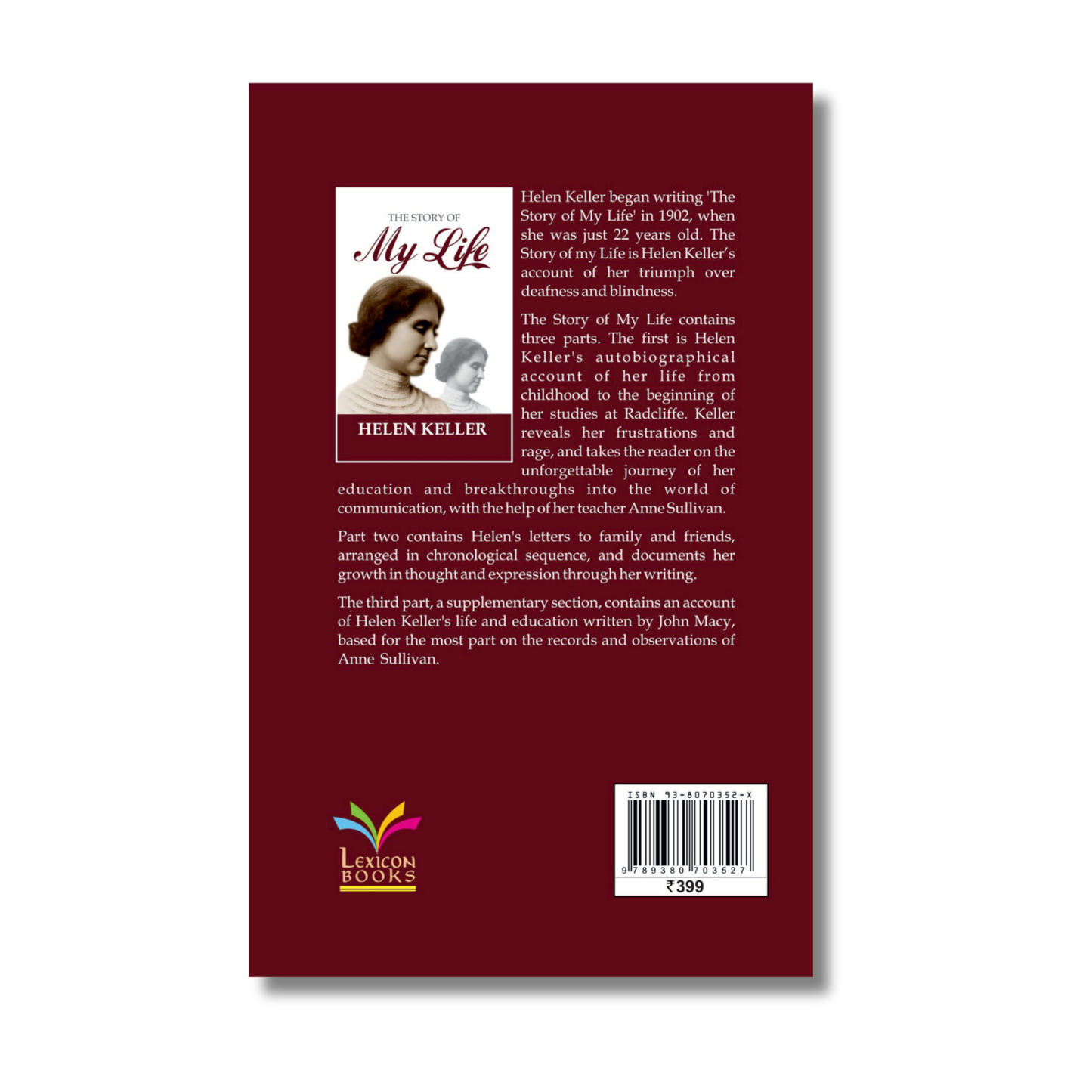
When she was 19 months old, Helen Keller suffered from a severe illness that left her blind and deaf. Soon, she also became mute. Her firm struggle to beat these handicaps, with the support of her inspired teacher, Anne Sullivan, is one of the extraordinary stories of human courage and commitment. In this classic autobiography, which was first published in 1903, Miss Keller describes the initial 22 years of her life, including the magical moments at the water pump while remembering the connection between "water" and the cold liquid flowing over her hand. She understood that objects have names. Various other aspects of Helen Keller's life are described here in clear, straightforward prose with wonderful imaginative presentations. This extremely moving memoir offers an unforgettable representation of one of the outstanding women of the 20th century.
Helen Adams Keller (June 27, 1880 – June 1, 1968) was an American author, disability rights advocate, political activist and lecturer. Born in West Tuscumbia, Alabama, she lost her sight and her hearing after a bout of illness when she was 19 months old. She then communicated primarily using home signs until the age of seven, when she met her first teacher and life-long companion Anne Sullivan. Sullivan taught Keller language, including reading and writing. After an education at both specialist and mainstream schools, Keller attended Radcliffe College of Harvard University and became the first deafblind person in the United States to earn a Bachelor of Arts degree.
Keller was also a prolific author, writing 14 books and hundreds of speeches and essays on topics ranging from animals to Mahatma Gandhi. Keller campaigned for those with disabilities and for women's suffrage, labor rights, and world peace. In 1909, she joined the Socialist Party of America (SPA). She was a founding member of the American Civil Liberties Union (ACLU).
Keller's autobiography, The Story of My Life (1903), publicized her education and life with Sullivan. It was adapted as a play by William Gibson, later adapted as a film under the same title, The Miracle Worker. Her birthplace has been designated and preserved as a National Historic Landmark. Since 1954, it has been operated as a house museum, and sponsors an annual "Helen Keller Day".