Skip to product information
1 of 2
Books-Business

The Wealth Of Nations

By AS Adam Smith Author
₹299 ₹499 40% off

You save ₹200

Inclusive of all taxes

15 people viewing now
Shop with peace of mind
Make it special+₹ 49.00
Qty
Added to cart successfully.
Offers
Share
WhatsApp
Link copied.
View full details

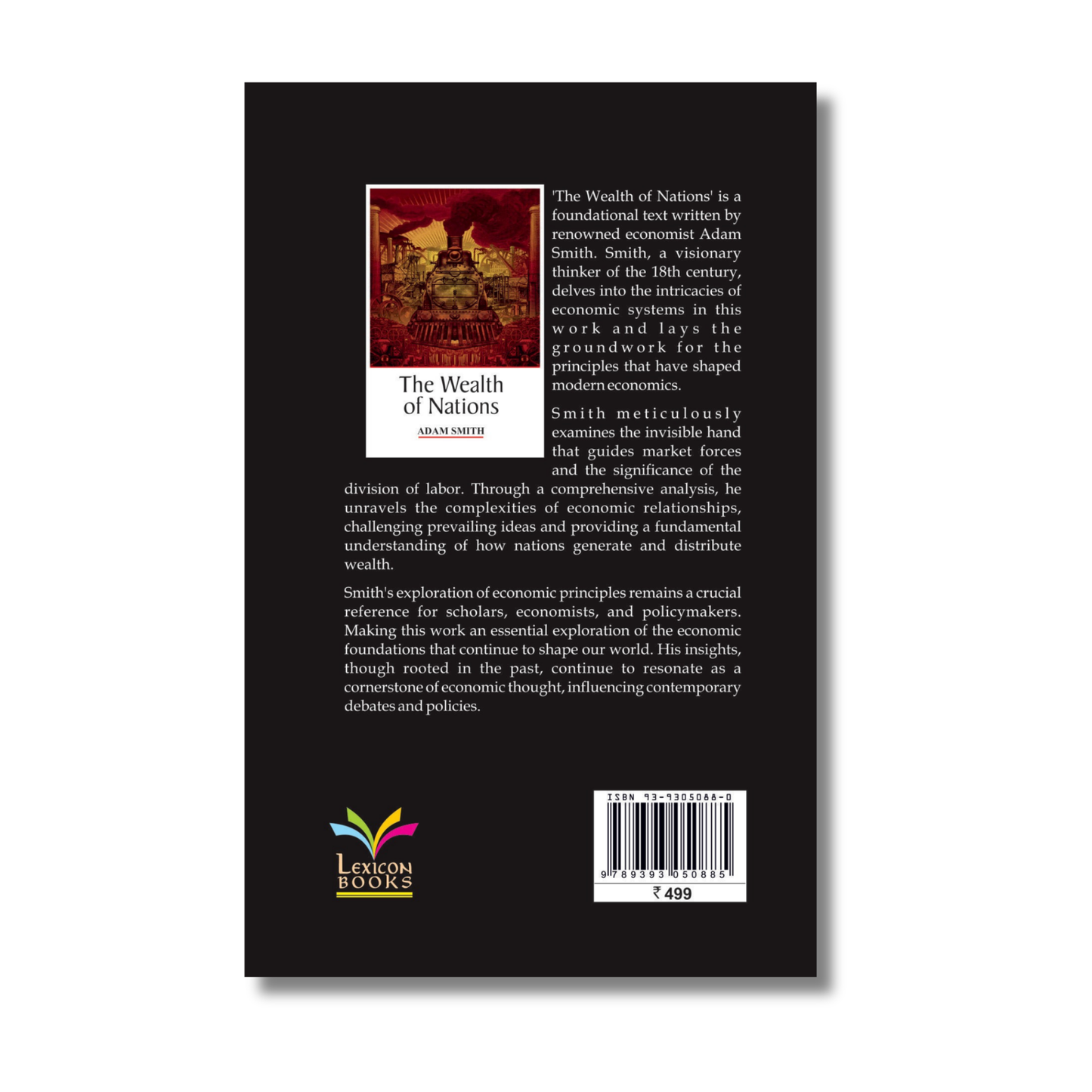
Even after two centuries since its first publication in 1776, The Wealth of Nations remains as influential as it was deemed before. Smith has elaborated on his thesis that it is human?s natural inclination towards self-interest that leads to prosperity; they add to public interest through their everyday choices. This book gives an insight into extensive assessment of the creation of a nation?s wealth; it examines the division of labour, the origin and use of money, the division of stock, the rise and progress of cities and towns after the fall of the Roman Empire, the systems of political economy and the taxes on various private revenues.

Product Highlights
Full specifications at a glance
Publisher ‏
‎ Lexicon Publication
Language ‏
‎ English
Format
Paperback
Paperback ‏
‎ 1144 pages (may vary)
ISBN-10 ‏
‎ 9387779467
ISBN-13 ‏
‎ 978-9387779464
Adam Smith

Adam Smith

Adam Smith (16 June 1723 NS (5 June 1723 OS) – 17 July 1790) was a Scottish moral philosopher, pioneer of political economy, and a key figure in the Scottish Enlightenment. Smith is best known for two classic works: The Theory of Moral Sentiments (1759), and An Inquiry into the Nature and Causes of the Wealth of Nations (1776). The latter, usually abbreviated as The Wealth of Nations, is considered his magnum opus and the first modern work of economics. Smith is cited as the father of modern economics and is still among the most influential thinkers in the field of economics today. Smith studied social philosophy at the University of Glasgow and at Balliol College, Oxford, where he was one of the first students to benefit from scholarships set up by fellow Scot, John Snell. After graduating, he delivered a successful series of public lectures at Edinburgh, leading him to collaborate with David Hume during the Scottish Enlightenment. Smith obtained a professorship at Glasgow teaching moral philosophy, and during this time he wrote and published The Theory of Moral Sentiments. In his later life, he took a tutoring position that allowed him to travel throughout Europe, where he met other intellectual leaders of his day. Smith laid the foundations of classical free market economic theory. The Wealth of Nations was a precursor to the modern academic discipline of economics. In this and other works, he expounded upon how rational self-interest and competition can lead to economic prosperity. Smith was controversial in his own day and his general approach and writing style were often satirised by Tory writers in the moralising tradition of William Hogarth and Jonathan Swift. In 2005, The Wealth of Nations was named among the 100 Best Scottish Books of all time. The minor planet 12838 Adamsmith was named in his memory.
About the author Adam Smith
Scottish moral philosopher and political economist; founder of modern economics

Adam Smith (16 June 1723 NS (5 June 1723 OS) – 17 July 1790) was a Scottish moral philosopher, pioneer of political economy, and a key figure in the Scottish Enlightenment. Smith is best known for two classic works: The Theory of Moral Sentiments (1759), and An Inquiry into the Nature and Causes of the...